You are not logged in. You can log in or create an account to save favorites and join collections. more info
Being-Time: Uniting Self and Moment

The discussion centers on the concept of "Being-Time" (Uji) as introduced by Dogen, emphasizing the indivisibility and simultaneity of time and being. It explores how koans, often perceived as historical stories, should be understood as immediate personal experiences. The talk stresses that understanding "true self" and "realizing original face" involves recognizing the totality of being, transcending individual self-perceptions, and confronting inherent doubts about self and time.
Referenced Works and Associated Concepts:
-
"Being-Time" (Uji) by Dogen:
Explores the intricate relationship between time and being, suggesting both are unified and reflect each other continually in the present. -
Moon in a Dewdrop - Zen Essays by Dogen, edited by Kazuaki Tanahashi:
Contains key translations of Dogen's fascicles, providing essential insights into Zen Buddhist teachings on the nature of time and existence. -
Heart Sutra:
Invoked in the dialogue for its fundamental formula of "form is emptiness and emptiness is form," highlighting the non-dual nature of reality, similar to the relationship between being and time. -
Koans in Zen:
Used as a teaching tool to bring stories into the present moment, urging practitioners to recognize them as pertinent to their current experience and understanding of self. -
The Concept of True Self in Buddhism:
Discussed as an exploration of totality of being beyond individual identity, challenging practitioners to inquire into the nature of self and reality.
AI Suggested Title: Being-Time: Uniting Self and Moment
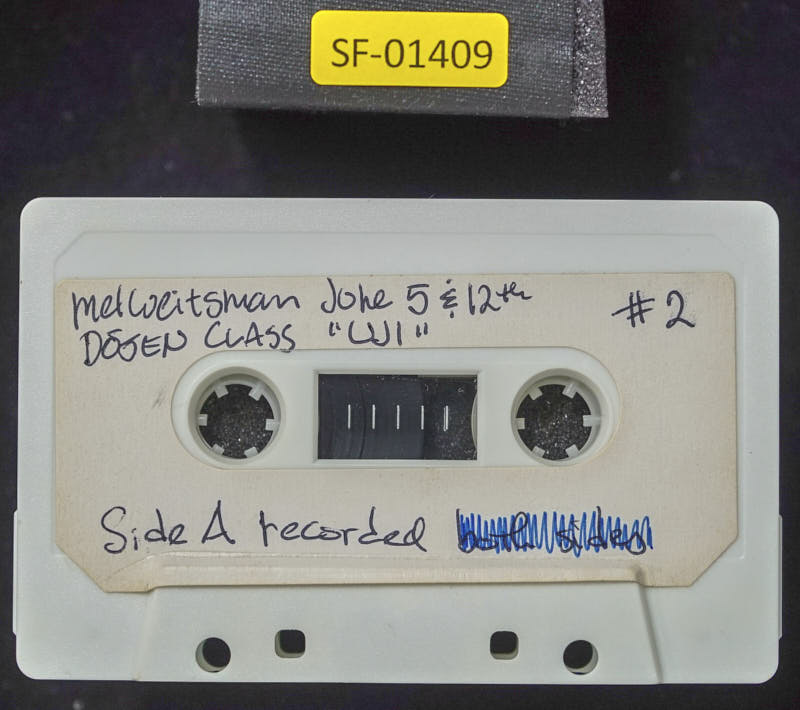
#BZ-round3 - - unidentified radio show on side B
are all time and times so this time is all times and this being is all beings do you have any questions about what that means? When you say in the original, what is in the original? Well, in the characters, Chinese characters, in the original Uji.
[01:02]
Oh, in the original character. In the original Uji. The original means what this is translated from. Oh. And then, Glorious Radiance. He says, Buddha's body is described as tall and golden-colored, radiating light. Buddhas and their radiance, even the strange figure of the Ashura, are all time, not as remote appearances in some other realm, but as your own being time, right here, in the instant present. So this is just like a koan. A koan looks like it's about some Chinese Zen master in the Tang Dynasty talking to somebody as an event in the past. But you have to see a koan as something that's happened to you right now. Otherwise, it's just a story. So the difference between a story and a koan
[02:07]
is that the story is about something that happened in the past. And the koan is a story that looks like a story in the past, but it's really your story in the present. So a monk asked Joshu, does the dog have Buddha nature? And Joshu said, woo. it sounds like a story that happened in the past but it's really a story about you right now it's your story right now so in the same way when Dogen talks about Buddha's golden body radiating light
[03:09]
He's talking about you right now. So when he says, I stand beside the highest mountain peak. I move on the deepest depths of the ocean floor. I am three heads and eight arms. I am eight or 16 feet. He's talking about you or me, not something else, not something distant. We have to see this in that way and look at our own time and our own being. And then, please, footnote three says, the so-called 12 hours, the day was divided into 12 in the old horary arrangement. And time is something we normally take advantage. And evidence is an obvious example of the changes of the seasons.
[04:13]
And then in footnote number four, he says, the nature of an unenlightened man's doubts and uncertainties is such that they rarely lead him to radical doubt concerning his own time being itself, his present doubt. He shouldn't call it into question, but even while he doesn't and remains an illusion, that does not alter the fact that his doubts, like everything else, are part of the environment. Well, we just understood that, right? And then footnote five, the self, or I, is the true self, the self in its mode of suchness. Usually, the true self is with a capital S. I'm surprised you put it with a small s. Small s usually means individual self, whereas a capital S usually means big self, or our true self.
[05:15]
So true self is the whole being, or totality of being, is our true self. Our small self is John and Joe and Mary, which is an expression of our true self. about it is not our whole true self. So in Buddhism, we have to doubt our self. We have to raise the doubt about our self. Who is this? What is this self that I think is a self? That's the main practice of Buddhism, to bring up the doubt about this self. and understand what it is, who we really are. So ultimately, when you realize your original face, so to speak, we realize that our true self is all being, totality of being.
[06:28]
So when Dogen says, we set the self out in array and make that the whole world, it means that the whole world actually is our self. Our true self is the whole thing. So you must see all the various things of the world as so many times. We don't usually tend to think in terms of times, we tend to think in terms of things. When I see you, I can say, what time are you? These things do not get in each other's way because any more than various times get in the way of each other. And then he has a footnote here that says, example, a bamboo is a bamboo or bamboo time and does not obstruct a pine tree being itself, which is pine tree time.
[07:36]
night is night or nighttime and does not impede day which is daytime so yes are all these times one one time well they're also separate they're one the separate times of one time parts of the time Parts of time? Well, if you can take time apart, you can say that, but can you take time apart? Conceptually. Well, conceptually, yeah. Time, well, time is, what is time? It's the rising and disappearing of rising and falling of events and Time is a being, right?
[08:44]
Time is events. So, you can say, I think he said something about part-time, but part-time is part-time being. Anyway, you know, we can chop up time into infinitesimal pieces. And yet, if you chop up time in infinitesimal pieces, do you destroy it? Does it come apart? Can you toss it around? So we tend to think of it as a thing, right? But is time a thing? It is things, but it's... you know, when you start to explain it, then it gets bigger and bigger.
[09:45]
So, it's fun to play with it. But we have to remember that all of our definitions are just play. Playing. With it. Which is okay. We should play with it. And so, And you must see that all the various things of the whole world are so many times. These things did not get in each other's way any more than the various times get in the way of each other. So, because of this, there is an arising of mind at the same time, and it is the arising of time of the same mind. So, it just depends on which way you want to say it. use the word mind in order to talk about time, or do you want to use the word time to talk about mind? So whatever we're talking about, we're talking about time, whether or not we mention the word time.
[10:53]
And when we're talking about time, we're talking about something, even though we may not be talking directly about something, or mention it. But if you talk about something, you're at the same time talking about the time of this something. And if you're talking about time, you're talking about the something of time. It's just like talking about form as emptiness and emptiness as form. We tend to think of form as a sign as something different from emptiness. It's easier to see time as something, though, than it is to see form It's the emptiness. No, I don't know where you want to stop, but it's time. Oh, nine. What time did these we stop?
[11:57]
Nine, right? Nine. Well, we got to just about where I thought we should get to. Not bad. So I know you. Tanahashi divides it into nineteen sections, and six into nineteen is eight in relation. It's probably three seconds, and more have to do with it. If you haven't got both of these, you might compare them and then write down the number in the section that Tom will help you as you buy me. It's a bargain copy of a hardbound book in a bookstore. It's good if you compare the two. And I urge you to get a copy of this book. We have them in a bookstore. They're actually quite inexpensive. You don't want to buy it.
[12:58]
They're out from your friend's copy. You'd be surprised how inexpensive they are. I don't want to copy it. I force you to buy the book, put pressure on you to buy the book. Because it's kind of like a textbook for a fact that The book is selling at a very low rate. I don't know how much it is in a bookstore, but most white prints went out of business. And they were publishing it. And they sold us a whole lot of copies that they had, very cheap. And so we're selling them very cheap to students. And so I would suggest that you rush down there and buy one.
[14:01]
But not right now. We're using both translations. And if you don't have the book, then you're missing one of the translations. But you can look down with somebody else or something. But anyway, I highly urge you to get a copy of Moon and the Dewdrop because it really has a lot of basic fascicles of Dogen that are translated, laboriously translated for your benefit. happily translated for your benefit now would anybody care to say anything like summing up
[15:18]
or making some kind of memorable or statement about something that was memorable about what we studied last time? Anybody say anything about what we did last time? Yes. I couldn't determine whether the lecture finished first and started. Lecture? Yes. What lecture? I didn't think of it as electric. Okay, if what? It just was. Do you remember anything about, you know, just anything about what we talked about last time?
[16:36]
Even at the risk of being inaccurate. Yes? We read the first part of case one, one hundred and fifty and one hundred and fifty. I recall it was the beginning time, and the, uh, uh, six-six months was going to the body. It's better than that. You're not clear about what context it was in? You mean like what 16-foot golden body is or what it's related to? What it is. Buddha. It's a kind of... imaginative description of Buddha. Sixteen feet is just one of the characteristics of the idealized imaginative Buddha from India.
[17:43]
You know, they say the 16-foot Buddha body with the various characteristics, and they name various characteristics, of what an idealized Buddha would be in that time. 32 characteristics. 16-foot golden body is one of them, one of the characteristics. So what he says is, this characteristic, this Buddha, is being time. And then he enumerates all these various things that are being time. That's right in the very beginning, right? He says, that's being time, this is [...] for the time being. That's a kind of cute way of saying being time, for the time being. That puts it into our colloquial language, right? We say, well, for the time being, and what we mean when we say the time being, what do we mean by that anyway?
[18:48]
We say, well, for the time being, let's do it this way. But we don't really think so much about what that means when we say it. Do we? For the time being means now. Now. But we don't think of all the implications of now when we say it. So when he uses it in this way, it kind of gives it a more deep meaning for the time being. It gives it, rather than just a casual meaning, it gives it a very profound meaning. Because equates being with time, and time with being. And then he goes on to elucidate. What? What's his point? Yep.
[19:52]
What did you say? I mean, Mark, we didn't see him back there. It seems to me, the sense that it means he's talking about the relationship between how we experience this also tends to segment things up to the past and future. And I don't remember the passage, but it diminishes the experience, the dull experience in one sense. And he's saying that there's an intimate connection between past and present and future and their own. are manifested moment by moment. What I mean, what art is being, and other reasons to write it up. There's a connection between past and present. And yet, there is no hindrance that each of these things, in a sense, is connected in one thing. But it also has a unique property to evolve.
[20:53]
I was just going to read a sentence. Even though you don't have doubt about the 12 hours that it's not to say, you know, then, so, for me, it's just like, we don't have a lot of doubt about, you know, using time, you know, and how we function with time. Using the concept of time. Yeah. You know, what it is. What it is. That's a good point. Also, that doubt, about time, the idea that time isn't segmented, isn't necessarily... It isn't only segmented. It isn't only segmented, yes. But that doesn't just naturally arise. It seems so obvious to us. that in time is this very moment that the Buddhist teaching calls in the moment.
[22:09]
There is only this eternal moment according to the Buddhist teaching. There's no past, only present, no future. Just in time, it's articulating the Buddhist understanding that everything that Buddha Well, we did the first three sections And the other translation is not segmented into sections. The translator makes up the sections.
[23:13]
But nevertheless, they do parallel each other. And I'll read up to the third section, which is what we did last time. We did one, two, three. And then we'll start with the fourth section. An ancient Buddha said, For the time being, stand on top of the highest peak. For the time being, proceed along the bottom of the deepest ocean. For the time being, three heads and eight arms. For the time being, eight for six inches. For the time being, a staff or lift. For the time being, a pillar or lantern. For the time being, the sons of Zong and Li. For the time being, the earth and sky. when we talked about it back then. For the time being here means, time itself is being, and all being is time.
[24:15]
A golden 16-foot body is time. Because it is time, there is the radiant illumination of time. Study it as the 12 hours of the present. Three heads and eight arms is time. Because it is time, it is not separate from the 12 hours of the present. Even though you did not measure the hours of the day as long or short, far or near, you still call it 12 hours. Because the signs of times coming and going are obvious, people do not doubt it. Although they do not doubt it, they do not understand it. Or when sentient beings doubt what they do not understand, their doubt is not firmly fixed. Because of that, their past doubts do not necessarily coincide with the present doubt. Yet doubt itself is nothing but time. The way to self-arrays itself is the form of the entire world. See each thing in this entire world as a moment of time. Things do not hinder one another just as moments do not hinder one another.
[25:20]
The way-seeking mind arises in this moment. A way-seeking moment arises in this mind. It is the same with practice and with attaining the way. Thus, the self setting itself out in array sees itself. This is the understanding that the self is time. You know, the self setting itself out in array sees itself is an interesting statement because the self has no special characteristics. The true self is called emptiness. The reason it's called emptiness is because it has no special characteristics. And this thing which has no special characteristics has many characteristics.
[26:23]
And its many characteristics are called all things. So all things is the no-things way of seeing itself, by setting itself out in the way as things. This is the understanding that the self is time. Could you take that formula? That's the formula from the Heart Sutra. Emptiness is form? Yeah, and then you're just putting this sentence into the form of that formula. You're interpreting that sentence according to. Oh yes, I'm interpreting that. Emptiness is form. Because emptiness is form.
[27:25]
The self setting itself out in a ray sees itself. That's emptiness is form. The self is time. As soon as we have form, we have time. There is no form, there is no time. Well, I don't know if that's so or not. Logically, that's true. No form, no time. So that's right, since no form is the time of timelessness, you can say it. But this is an interesting statement, isn't it?
[28:23]
@Transcribed_UNK
@Text_v005
@Score_80.59